Do you know that many pre-packaged food products need a Nutrition Facts label? In some cases, you can apply for an exemption, provided certain criteria are met. In those cases, nutrition labelling might not be needed.
Most food businesses are required to have nutrition labels on their pre-packed food products. The Food Standards Agency (FSA), which is responsible for food safety and food hygiene in England, Wales and Northern Ireland, recommends that a product meet compliance requirements before it can be considered marketable. The FSA works with local authorities to enforce food safety regulations, and it also visits meat plants to check that standards are being met.
Mandatory nutrient information on food labels:
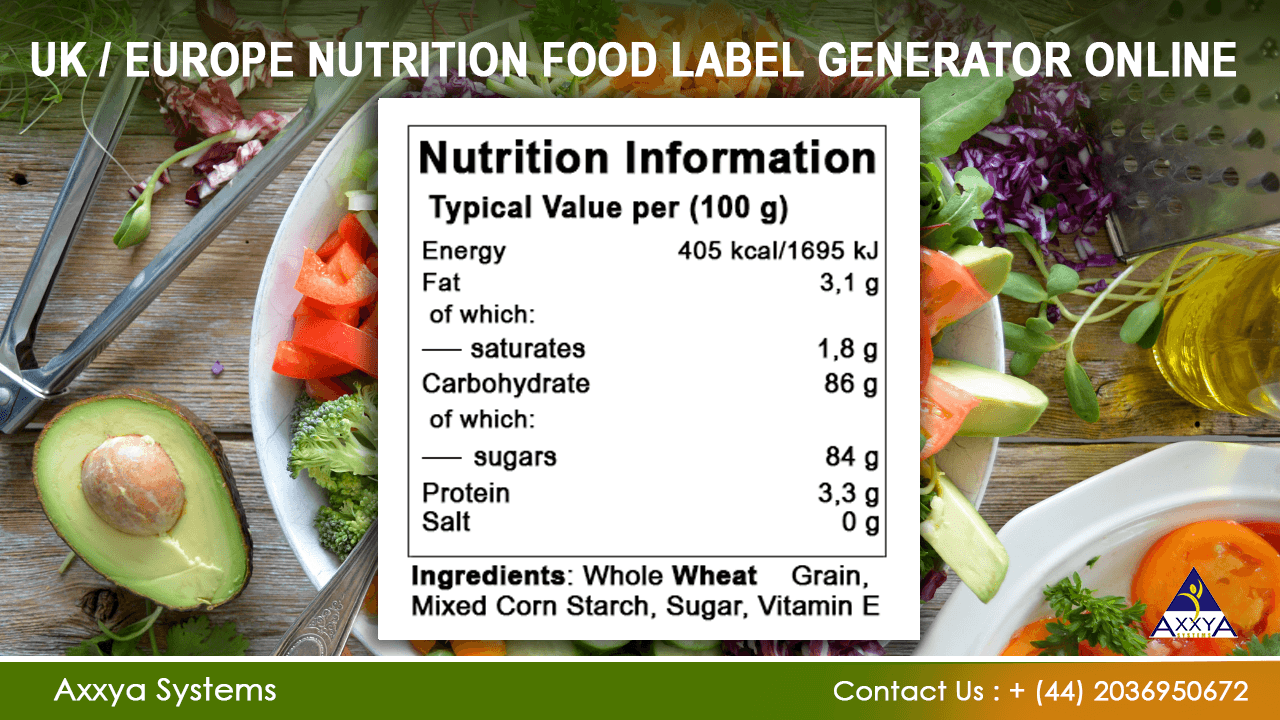
While providing nutrition information, food businesses have to declare:
- Energy value
- Amounts of fat
- Saturates
- Carbohydrate
- Sugars,
- Protein
- Salt
Prepacked foods need to declare the nutritional values of the food products. It is usually referred to as the back-of-pack nutrition labelling.
Calories and Reference Intake (RI)
Nutrition labels need to display the amount of energy, such as kilocalories and kilojoules, and the amounts of fat, saturated fat, carbohydrates, sugars, proteins, and salt. All these nutrients need to be expressed in grams present in 100g (or 100 ml) of the food. FSA also rules that nutrition information may be expressed per portion, provided the number of portions in the pack is quoted.
Energy
The amount of energy in foods and drinks must be shown in kilocalories (kcal) and kilojoules (kJ). FSA guides say that the average man needs around 2,500kcal (10,500 kJ) a day to maintain his weight, while the average woman needs around 2,000kcal (8,400 kJ). These tend to vary depending on an individual’s age and levels of physical activity, among other factors. Calorie intake will vary for children, depending on a number of factors, such as age and how physically active they are.
Reference Intake (RI)
The Reference Intake (RI) is a guide to ballpark nutrient levels, including fats, saturated fats, salt, and sugar, as well as the energy you need for a healthy diet. It is shown as a percentage (%) on the food label, and the RI values tend to vary from nutrient to nutrient and give a useful indication of how much the average person needs.
Date Labels
Most foods and drinks must be marked with either a ‘Use by’ or ‘Best before’ date. These indicate guidance for the correct storage of the product. For example, raw meat or fish, cooked sliced meats, dairy products, prepared salads, etc.
Presentation of nutrition information
FSA rules state that nutrition information on nutrition labels should be presented in tabular format, with numbers aligned where space does not permit. The declaration should appear in linear format; for example, the energy value must be expressed in kilojoules (kJ) and kilocalories (kcal), and the amount of nutrients must be expressed in units (g, mg, or mcg).
Food nutrition information label templates in the UK show all elements are included next to each other. Nutrition data on the labels should appear per 100 g/ml when using the measurement units and as a percentage for the reference intake (RI).
How to calculate the nutritional values?
FSA legislation allows various ways to calculate nutrient values. These include laboratory analysis, food nutrition facts analysis, and labelling software.
The most economical and convenient form is the use of a tool for calculating nutritional values of food products and creating nutrition label template free trials for the UK is much more efficient, faster, and cost-saving.
Nutritionist Pro™ NexGen: UK/Europe Nutrition Food Label Generator
An online nutrition label generating tool, Nutritionist Pro™ NexGen is designed to help food businesses create food labels for the UK/EU. You can create unlimited label styles in English, French, and Spanish, and build an unlimited number of recipes/formulas using the European Food database in this online nutrient analysis application, making recipe creation very easy. You can add custom ingredients as needed and save labels in high-resolution images.
Want to see how easily you can create nutrition labels with Nutritionist Pro™? Try a free trial of the online Nutritionist Pro™ application.